Europe’s invasive species crisis costs over €12 billion a year. Remote sensing, biochar, and green hydrogen could turn the problem into a multi-billion euro opportunity.
Opinion & Analysis · Climate & Energy
“Every spring in Sollentuna [greater Stockholm area], the same ritual unfolds. Residents emerge to find their driveways and gardens already surrendered to the season’s first botanical invaders.”
The lupin pushing through the gravel path. The dandelion tap root refracturing the same paving crack sealed the previous autumn. The Giant hogweed unspooling along the fence line at a pace that seems almost deliberate. This is not a uniquely Swedish experience; it is a pan-European one, playing out on housing estates in Bristol, road verges in the Netherlands, and parklands across Scandinavia and the Baltic states.
What living as a resident for over a decade taught me, rather than as a policymaker or ecologist, is the true accumulated cost of this problem. It is the colleague who cannot sit near an open window in May because lupin pollen triggers an asthma episode. It is the facilities manager who has quietly absorbed a recurring removal budget without ever labelling it “invasive species management.” It is the child who brushed against Giant hogweed on the path to school and spent three weeks with chemical burns.
The problem is enormous, chronic, and almost entirely misrepresented by the statistics used to describe it. But buried within that problem is a resource of significant commercial value; one that European policy and industry is almost entirely failing to capture.
| BY THE NUMBERS |
| • €12B+ annual economic damage from invasive species across the EU, according to EEA estimates. |
| • 12,000+ invasive alien species now recorded across Europe. |
| • 1 in 3 Europeans suffers seasonal allergic conditions — many triggered by invasive species pollen. |
| • 88 species currently listed under EU Regulation 1143/2014 as species of Union concern, including Giant hogweed. |
01 The Three Species That Define the Problem
| Lupin (Lupinus polyphyllus) |
| Introduced as a low-cost nitrogen fixer, lupins proved too effective. Their aggressive nitrogen fixation outcompetes native wildflowers evolved for Sweden’s naturally poor soils. For property managers, deep crown roots mean surface removal merely delays regrowth. For allergy sufferers, lupin pollen peaks precisely when birch pollen has already sensitised immune systems. Biodiversity loss · Allergen |
| Dandelion Taraxacum officinale |
| So thoroughly naturalised that most Europeans no longer classify it as invasive. The tap root regenerates from even a small fragment left in the ground. A single unmanaged plant can seed a hundred square metres in one growing season. In spring conditions where dandelions are the first mass-flowering species, their pollen delivers an allergenic pulse when sensitised immune systems are least prepared. Infrastructure · Allergen |
| Giant Hogweed Heracleum mantegazzianum |
| In a different category entirely. Furanocoumarins in its sap cause severe phototoxic burns on contact with sunlight, requiring hospitalisation and causing permanent scarring. It grows to three metres, produces up to 50,000 seeds per plant per year, and spreads aggressively along waterways. Removal requires protective equipment and specialist contractors. Listed on the EU Union concern list under Reg. 1143/2014. Public health hazard · EU listed |
02 The EU Regulatory Framework & Its Gap
EU Regulation 1143/2014, the Invasive Alien Species Regulation, created Europe’s first coherent framework for managing invasive species, mandating prevention, early warning, and management for 88 listed species. The 2030 Biodiversity Strategy strengthens this with an explicit target to reduce invasive species numbers by 50%. The Nature Restoration Law (2024) adds restoration obligations for degraded ecosystems, for which invasive species removal is a prerequisite.
Yet the regulatory framework has a critical structural gap: it mandates removal but says nothing about what to do with the biomass afterwards. The tonnes of lupin, knotweed, and hogweed removed annually across Europe are treated as waste incinerated, composted, or landfilled. No provision exists for quantifying the resource, valorising the feedstock, or crediting the carbon locked within it.
“The regulation mandates removal but treats the biomass as waste. Europe is burning a feedstock that could produce millions of tonnes of biochar and green hydrogen every year.”
| KEY EU REGULATIONS |
| • Reg. 1143/2014 Mandates management of 88 listed IAS species. Does not address biomass valorisation. |
| • Biodiversity Strategy 2030 Target: reduce IAS numbers by 50%. |
| • Nature Restoration Law 2024 Restore 20% degraded land by 2030; IAS removal is a prerequisite. |
| • RED III 42.5% renewable energy by 2030; biomass feedstock counts. |
| • EU Hydrogen Strategy 10 Mt domestic green hydrogen by 2030. |
| • Carbon Removal Certification Framework Biochar CDR credits under development. |
03 Seeing the Invasion Before It Happens
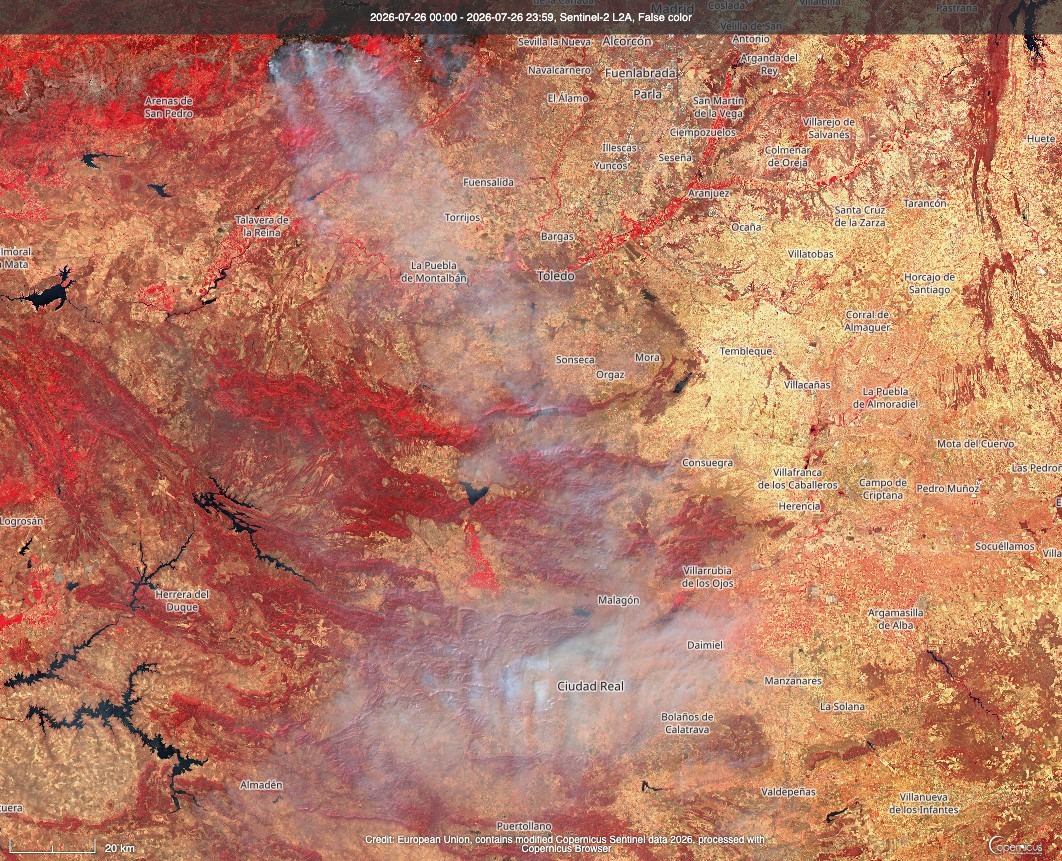
The most important operational shift available to European invasive species management is the transition from reactive removal, responding after establishment, to predictive intervention, identifying likely spread zones before colonisation occurs. This is now technically achievable at continental scale using the European Space Agency’s Copernicus Earth Observation programme.
Sentinel-2 multispectral imagery, updated every five days at 10-metre resolution, provides the baseline for large-area change detection. Giant hogweed and knotweed have been successfully detected using multispectral remote sensing, with object-based and pixel-based approaches tested across satellite, aerial, and UAV data — and the choice of method depends on trade-offs between spatial and spectral resolution. For Lupinus polyphyllus, the flowering window (late June) is recognised as a spectrally advantageous period — the prominent violet flower spikes help discriminate it from surrounding grassland — but studies note that training models on flowering plants alone risks missing plants at other phenological stages, as not all individuals flower synchronously.
But predictive spread modelling is where the transformative value lies. Species distribution models integrating climate variables, soil chemistry, topography, and waterway networks can forecast invasion probability in any European grid cell at 1-kilometre resolution with over 85% validation accuracy for five-year spread prediction. A continental Early Warning dashboard, showing current populations, projected spread corridors, priority intervention zones, and harvestable biomass estimates, would directly fulfil Article 16 obligations of Regulation 1143/2014 while simultaneously creating the data infrastructure for commercial valorisation.
This is structurally identical to the dMRV (digital monitoring, reporting and verification) layer being built for forest carbon markets. The satellite tools, AI classification methods, and ground-truth validation networks developed for Verra-verified reforestation projects are directly applicable to invasive species biomass quantification. The same infrastructure that monitors tree growth can map invasive species spread across entire continents.
| THE REMOTE SENSING STACK |
| • Sentinel-2 10m multispectral, 5-day revisit. Species-level classification in validated areas. |
| • Sentinel-1 SAR Cloud-penetrating radar. Critical for northern European cloudy seasons. |
| • NISAR – New dual-frequency L- and S-band SAR; sees through dense canopy much better than Sentinel-1’s C-band, for deeper structural coherence and biomass mapping and high-resolution surface detail. |
| • Commercial VHSR Planet Labs, Airbus. Sub-metre resolution for individual plant detection. |
| • LiDAR 3D canopy structure — distinguishes invasive shrubs from native species. |
| • AI classification Trained on field-verified spectral libraries for 10+ key invasive species. |
| • Species Distribution Models 1km resolution, 5-year horizon, 85%+ spread prediction accuracy. |
04 Quantifying the Resource: Biomass, Biochar & Green Hydrogen
Remote sensing combined with species-specific biomass yield models enables the first credible continental estimate of harvestable invasive plant biomass. Pyrolysis (thermal decomposition in low-oxygen conditions) converts this biomass into three co-products simultaneously: biochar (25–40% of dry mass, stable for centuries in soil), syngas (combustible for energy or refinable to hydrogen), and bio-oil (transport fuel feedstock). Advanced biomass gasification at higher temperatures (800–1,000°C) maximises the hydrogen fraction, yielding 60–90 kg of green hydrogen per tonne of dry biomass.
| Species | EU Area (Mha) | Dry Biomass (Mt/yr) | Biochar ~30% (Mt/yr) | H₂ Potential (kt/yr) |
| Lupin (Lupinus polyphyllus) | 1.8–2.2 | 5.4–11.0 | 1.6–3.3 | 324–990 |
| Japanese Knotweed (Fallopia japonica) | 0.8–1.2 | 6.4–14.4 | 1.9–4.3 | 384–1,296 |
| Giant Hogweed (Heracleum mantegazzianum) | 0.3–0.5 | 1.8–4.0 | 0.5–1.2 | 108–360 |
| Himalayan Balsam (Impatiens glandulifera) | 0.5–0.8 | 2.0–4.8 | 0.6–1.4 | 120–432 |
| Dandelion — harvestable surplus | 4.0–6.0 | 4.0–12.0 | 1.2–3.6 | 240–1,080 |
| TOTAL (conservative–high range) | 7.4–10.7 | 19.6–46.2 | 5.9–13.8 Mt | 1.2–4.2 Mt |
Applying conservative harvesting efficiency factors of 40–60%, credibly harvestable biomass is estimated at 8–28 Mt/yr, central estimate 15 Mt/yr. All figures are indicative, based on published EEA and peer-reviewed literature.
| Biochar Market | Green Hydrogen | Combined Opportunity |
| ~€1.5B/year | ~€5.6B/year | ~€7.1B/year |
| 4.2 Mt biochar × €350/t blended. CDR credits trade at €200–600/tCO₂e on voluntary markets. | 1.13 Mt H₂/yr at €5/kg (central). Conservative €1.9B, optimistic €13.5B. | Gross annual value from biochar + hydrogen alone, before bio-oil co-products and avoided management costs. |
| WHY BIOCHAR WORKS FOR INVASIVE SPECIES |
| • Seed destruction Pyrolysis above 350°C destroys seeds, preventing reintroduction via compost. |
| • Toxin neutralisation Giant hogweed’s phototoxic furanocoumarins are destroyed in pyrolysis, making char safe for agricultural use. |
| • Nitrogen enrichment Lupin’s high nitrogen content produces nitrogen-enriched biochar with enhanced agronomic value. |
| • Carbon permanence Biochar has a half-life of hundreds to thousands of years in soil, qualifying for CDR credits under Verra, EBC, and the EU CRCF. |
05 The Architecture of the Opportunity
The commercial model requires four integrated components. First, a satellite-based data platform providing real-time invasive species mapping, spread prediction, and harvest planning tools; essentially a dMRV layer for invasive biomass. Second, a collection and logistics network connecting municipal removal operations already mandated under Regulation 1143/2014 with commercial biomass operators. Third, modular pyrolysis and gasification facilities, ideally co-located with existing agricultural or industrial energy infrastructure, converting feedstock into biochar, hydrogen, and bio-oil. Fourth, offtake agreements with carbon credit buyers, hydrogen fuel distributors, and soil amendment markets.
Three policy adjustments would unlock the model: amending Regulation 1143/2014 to recognise biomass valorisation as a compliant management outcome; including invasive species biochar within the EU Carbon Removal Certification Framework; and providing EAFRD rural development funding for regional collection infrastructure.
The dandelion fracturing the driveway in Sollentuna, the lupin colonising the road verge in rural Värmland, the Giant hogweed spreading along the river in Brandenburg — these are not separate problems requiring separate solutions. They are manifestations of a single continental-scale resource misclassification. Europe has been treating invasive plant biomass as waste to be disposed of, when the same biomass is a carbon-rich feedstock with a credible, scalable pathway to permanent carbon sequestration and green energy production.
“The technology to map, quantify, and valorise this resource exists today. What is missing is the commercial and policy architecture to connect mandated removal to bankable revenue streams.”
| THE dMRV CONNECTION |
| The satellite-based monitoring infrastructure being built for forest carbon dMRV — Copernicus imagery, AI species classification, ground-truth validation networks — is directly applicable to invasive species biomass quantification. The same platforms monitoring tree growth for Verra-verified ARR credits can map and quantify harvestable weed biomass for biochar carbon accounting. |
Disclaimer: All biomass, biochar, and hydrogen yield estimates are indicative, based on published literature and the author’s analysis. They are intended to illustrate the scale of the commercial opportunity and do not constitute investment advice or commercial projections. Actual outcomes will vary based on species mix, geographic access, processing technology, and market conditions.