By Rishabh Khanna, Co-Founder & Co-CEO, Earthbanc
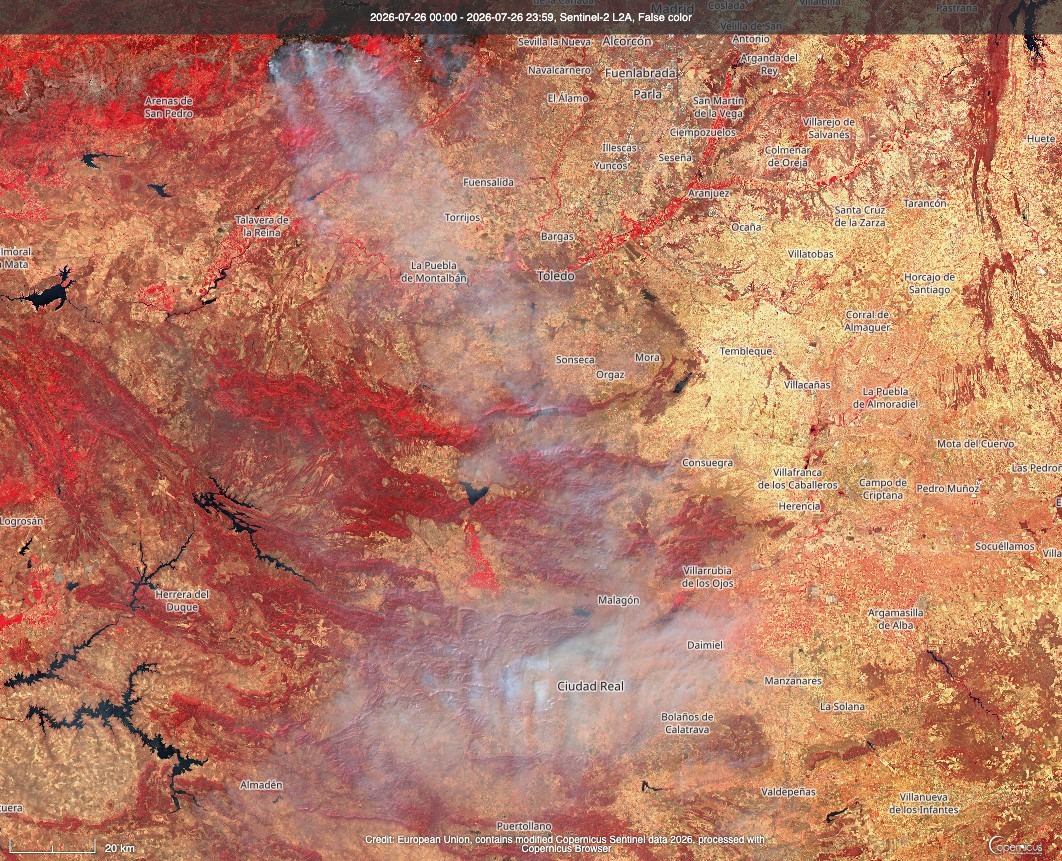
The summer of 2026 has given southern Europe one of its most destructive wildfire seasons on record. By early August, more than half a million hectares had burned across the European Union, according to the European Forest Fire Information System. France set a new national record for area burned. The fire at Ávila, at roughly 50,000 hectares, became the largest single wildfire in Spain’s recorded history. Greece lost five firefighters inside a week. Hundreds of thousands of people across Spain, France, and Greece were evacuated or told to prepare to leave.
The coverage has been relentless, and nearly all of it has been about fire. Hectares lost. Aircraft deployed. Villages evacuated. Very little of it has been about water, which is odd, because water is the part that explains the rest. These wildfires are not burning hotter because there is more fire in the world. They are burning hotter because the land underneath them has lost the ability to hold moisture.
That is a farming and forestry story as much as a firefighting one. And it is one we have some control over.
Lighting a fire was one of the great turning points in human evolution: the moment we stopped being at the mercy of the landscape and started shaping it. In the hundreds of thousands of years since, humans have developed an extraordinary range of techniques for managing fire: burning stubble to clear a field, torching understorey to open hunting grounds, using controlled flame to regenerate grassland for grazing. Indigenous peoples and traditional farmers across the world — from Aboriginal Australia’s cultural burning to shifting cultivators in Northeast India — still use fire deliberately, as a precise tool for reducing fuel load before it can become a hazard.
And yet today, fire has become one of the landscape’s greatest menaces.
Why Wildfires Are Getting Worse
The uncontrolled wildfires now tearing through forests, farmland, and grassland on every continent aren’t simply “more fire.” They’re a symptom of landscapes that have lost their resilience. Decades of unsustainable farming and forestry — monocultures, tillage that strips organic matter, drainage of wetlands, clear-felling that leaves soil bare — have left land increasingly devoid of moisture. Water tables have declined. A landscape that once held water in its soil, its root systems, its wetlands, now dries out faster and burns hotter.
Layer climate-driven extreme heat on top of that, and what used to be a manageable, even beneficial, low-intensity burn becomes an uncontrollable inferno. The very thing that indigenous fire practitioners used skillfully for millennia has, in a degraded landscape, turned into an existential threat — to biodiversity, to farmland, and to the people who live closest to the land.
Traditional Fire Management and the Khasi Hills of Meghalaya
Nowhere is this clearer than in most districts of Meghalaya, in Northeast India. There, Jhum cultivation — a form of swidden, or slash-and-burn, farming practiced across South and Southeast Asia for centuries — has traditionally worked as a genuinely intergenerational skill. Children grow up as active participants in it, not bystanders: they are taught to contain a controlled burn to the plot being prepared, to read wind direction, to manage water through both the dry season and the monsoon, and to stop a fire from ever reaching a neighbor’s land. None of this is an argument for putting children near danger. It is an observation about how well-codified the knowledge was: reliable enough, and safe enough in practice, to be taught young and used under supervision. The burn itself has an agronomic purpose — it fixes potash in the soil ahead of planting crops like pineapple, betel nut, or jackfruit — and containing it safely was, for generations, simply part of growing up in these hills.
That system is now unraveling from several directions at once. National and state governments, along with international development agencies, have pushed to regulate or replace Jhum, citing environmental degradation, and have piloted alternatives such as conservation agriculture in neighboring states. At the same time, communities that once moved their agricultural plots across the landscape — leaving long fallow periods for the land to recover between burns — have moved to settled farming, so the same plots are cultivated on much shorter cycles, giving the soil less time to regenerate. And market pressure has pulled farming toward monoculture cash crops: broom grass, for instance, is a lucrative crop in the region but also a highly invasive, water-hungry species that degrades the land faster than it can recover. Similar dynamics are playing out elsewhere in Northeast India, where oil palm monocultures have expanded rapidly across the hills under state land-use policy.
The result is a quiet but consequential loss: a body of fire knowledge, precise enough to be entrusted to children, is being displaced just as the region needs it most — replaced not by something better suited to a changing climate, but by shorter fallow cycles and thirstier monocultures that make the landscape more fire-prone, not less. The tension isn’t really between “traditional” and “modern” land management; it’s between a system calibrated over generations to a particular landscape, and one calibrated to market returns over a much shorter horizon.
So: is there any hope? I think there is — but it depends on treating fire not as a problem to be suppressed, but as a symptom of a landscape relationship we need to rebuild. Four approaches, working together, point the way.
Regenerative Agriculture and Soil Water Retention
The first line of defence is under our feet. Regenerative agriculture — cover cropping, reduced tillage, diverse rotations, integrating livestock and trees into farming systems — rebuilds soil organic matter and, with it, the soil’s capacity to hold water. A field that can absorb and retain moisture is a field that resists both drought stress and fire spread. This isn’t a return to the past; it’s a redesign of how we farm, with soil moisture and biological activity treated as the foundation of productivity rather than an afterthought.
Regenerative Forestry and Fuel Load Reduction
The second is what we do with our forests. Decades of fire suppression combined with even-aged, single-species plantation forestry have left many landscapes with dangerously high fuel loads and little of the natural heterogeneity that once slowed fire spread. Regenerative forestry — mixed-age stands, native species diversity, selective thinning, and yes, the reintroduction of controlled, low-intensity burning where ecologically appropriate — restores a forest’s own defences. It’s a return to working with fire’s natural role in many ecosystems, rather than pretending it can be eliminated entirely.
Remote Sensing, Firebreaks and Early Wildfire Detection
The third is detection and response. Satellite and drone-based remote sensing now make it possible to track fuel load, soil moisture, and fire risk across vast landscapes in near real time — flagging danger zones long before a spark turns into a crisis. Paired with well-maintained fire guards (firebreaks) and rapid-response teams positioned using that same data, this combination shifts fire management from reactive to predictive. It’s a technology layer that makes traditional fire stewardship more precise and more scalable.
Biochar: Turning Invasive Biomass Into Carbon Removal
The fourth — and the one closest to my own work — is turning the fuel load problem into an opportunity. Invasive species are frequently among the most fire-prone materials in a degraded landscape: dense, dry, fast-growing, and often exactly the kind of biomass that traditional fuel-reduction burning was designed to clear. Instead of burning that biomass and releasing its carbon straight back into the atmosphere, pyrolysis converts it into biochar — a stable, long-lived form of carbon that can be returned to the soil, where it improves water retention and soil health rather than degrading them further. Done well, this closes a loop: invasive, fire-prone biomass becomes a tool for the very soil-moisture restoration that reduces fire risk in the first place, while generating a genuine carbon removal outcome along the way.
What Has To Change
None of these four approaches works in isolation, and none of them is a silver bullet. But together, they represent something more fundamental than a technical fix: a shift from treating ecological boundaries — water tables, soil moisture, biodiversity — as constraints to be worked around, toward treating them as the preconditions for any of this working at all. Indigenous fire knowledge got this right long before remote sensing existed. The task now is to combine that knowledge with the tools we’ve built since, and to design the economics — carbon markets, land finance, agricultural incentives — so that regenerating a landscape’s capacity to hold water and resist fire is rewarded rather than left to chance.
Is there hope? Only if we stop asking how to suppress fire, and start asking how to rebuild the landscapes that make fire manageable again.