By Rishabh Khanna, Co-Founder & Co-CEO, Earthbanc

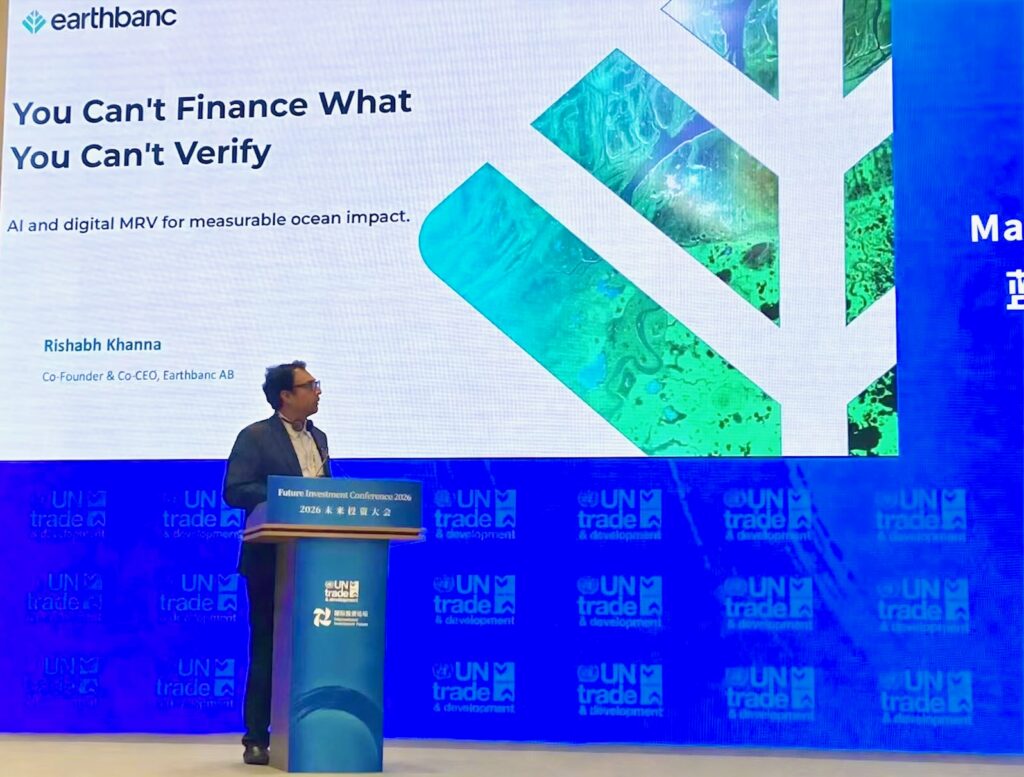
At UNCTAD’s Future Investment Conference in Xiamen this month, I spoke at a session on the ocean economy and future investment, alongside investors, industry leaders and academics. The question before us was where blue finance, the capital now moving into the ocean economy, should go, what it can expect in return, and where the risks lie. Four concerns ran through the discussion: industrial development, shipping safety, who shares in the benefits, and the ocean’s capacity to carry all of it.
Two of those four are about what gets built, and capital knows how to price them. The other two, who it reaches and what carries it, have no numbers at all. That gap is what I want to write about.
The premise was that the ocean economy has moved beyond extraction and shipping lanes into a single industrial system, linking marine renewable energy, ports, biotechnology and digital infrastructure. Offshore wind is no longer a pilot technology but industry at scale. Ocean-sited data centres were presented as a serious proposition, cooled by seawater. Marine biotechnology companies described turning fish and seaweed into food and materials. Growth, the session argued, comes from treating the ocean as a platform to build on rather than a stock to draw down.
That was the straightforward half of the discussion. The contested half concerned who all of it is for, and what holds it up.
Who is the capacity built for?
The chairman of Grameen Bank, the Bangladeshi microfinance institution, was also on the panel, and he challenged the room on inclusion. Who is all this being built for, he asked, and then answered himself: it cannot be for the few again.
New marine industrial capacity does not automatically reach the coastal communities and small operators most exposed to the ocean’s condition. Benefit-sharing is not a side commitment. It is one of the conditions that determine whether the capital deployed counts as sustainable at all. He was speaking about the more than three billion people who depend on marine and coastal biodiversity for their livelihoods.
We are assuming the ecosystem can sustain this
Offshore wind, ocean data infrastructure and marine biotechnology are all being built on the assumption that the marine systems beneath them will keep functioning as the industrial system scales. Marine ecosystems are fragile and have been deeply impacted by the extractive industrial economy in the last 150 years. Restoring them to a functional level requires investment.
Consider mangroves. Their roots desalinate the water and hold the coastline in place, so soil settles on the banks instead of washing out to sea. That sediment allows seagrass to establish, and seagrass is where fish spawn.
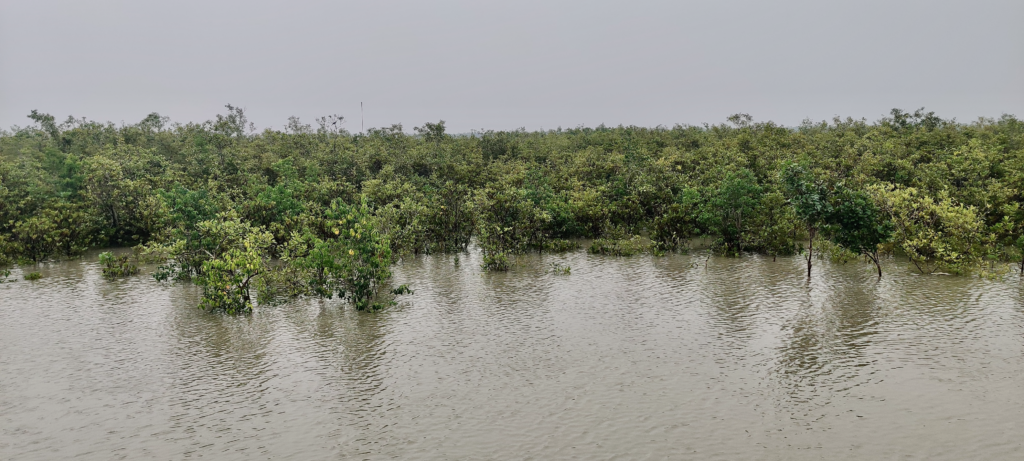
The fisheries and biotechnology executives who shared the stage with me are building businesses on fish that begin life in a mangrove. Mangroves also store two to ten times more carbon per hectare than mature terrestrial forest, and they are critical in supporting the coastline while they do it. Between the fish, the carbon and the shelter, a single hectare delivers roughly $16,000 a year in ecosystem services. Those funds do not appear in anyone’s accounts.
Why MRV is the missing layer
Capital moves on numbers that can be audited over time. Ecosystem services, carbon sequestration and fish stock recovery all require the same measurement, reporting and verification, or MRV, that carbon markets had to build for forests on land. Without it, the value claimed for mangroves, seagrass and coastal ecosystems remains theoretical.
Proving mangroves are working takes more than showing they have grown back. It means measuring what that return does to salinity, to the shoreline, to fish stocks and to household income.
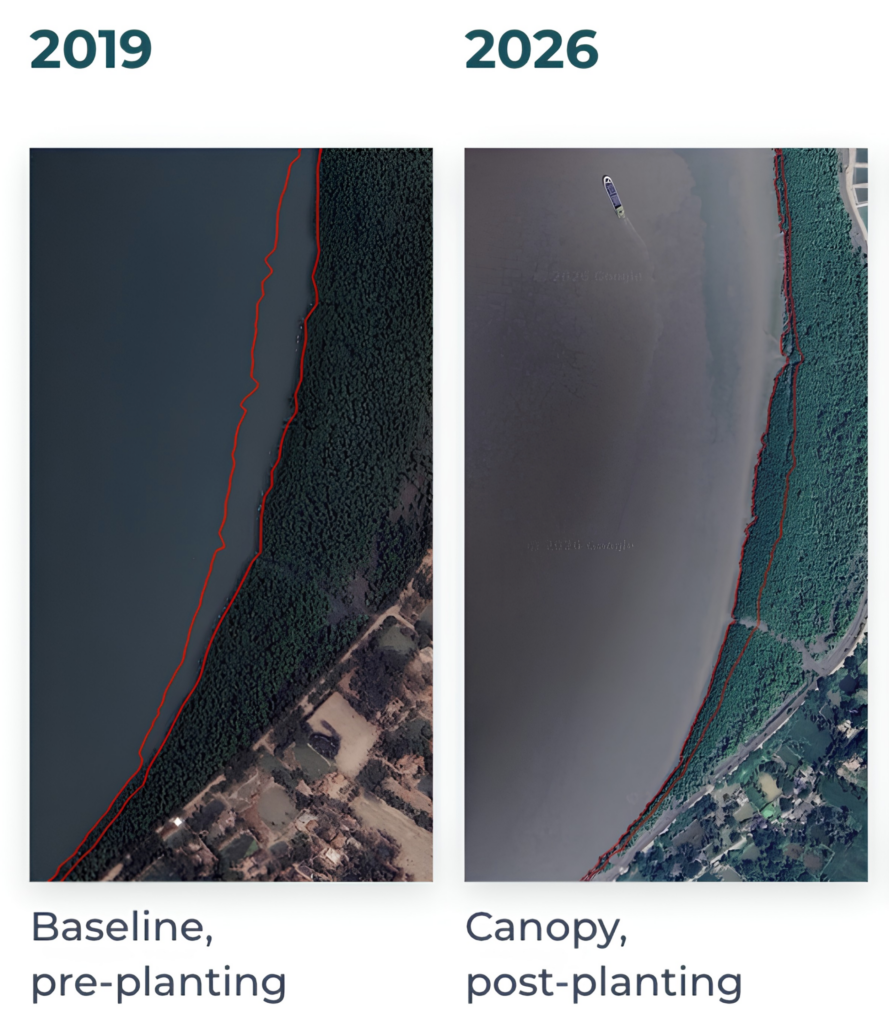
That is the work we have been doing in the Sundarbans, in West Bengal, since 2020. We have restored sixteen hectares. Of 38,000 trees planted, 30,400 are still standing, a survival rate of 80 percent across six years, and together they have sequestered an estimated 2,500 tonnes of carbon. On our Dayapur plot, satellite analysis comparing a 2019 baseline with 2026 shows canopy height rising from nothing to 6.1 meters along the shoreline, and demonstrates the mangrove area increasing by 14,175 square meters.
The method uses satellite data that separates land from water, with canopy change tracked across the same coordinates over seven years. Drone surveys and field photography verify what the satellites record. Every record passes through our operating system with a chain of custody attached, so that any claim can be traced to the data behind it.
The four concerns hold together or not at all
The four concerns are not separate agenda items. They are one blueprint for blue finance, and none of them works without the others. An industrial buildout that ignores carrying capacity is borrowing against the ecosystems it depends on. Benefit-sharing, in an economy where nothing has been built, has nothing to distribute.
This returns me to where the session began. Growth, it is argued, comes from converting technology, capital and ocean space into sustainable industrial capacity. Sustainable is doing a great deal of work in that sentence. Its logic only survives if all four concerns are financed as one system, rather than as a headline industry with sustainability and inclusion bolted on later.
Measurement is what makes that possible. Once a hectare of restored mangrove can be verified in the way any other asset is verified, it becomes something capital can weigh against everything else on the table. That work matters as much as the buildout itself, and it decides whether those data centres have an ocean worth cooling in.